Ever feel a sharp zap in your lower back that shoots down your leg and makes you rethink every life choice that involved sitting? Yeah. That might be more than "just back pain That's the whole idea..
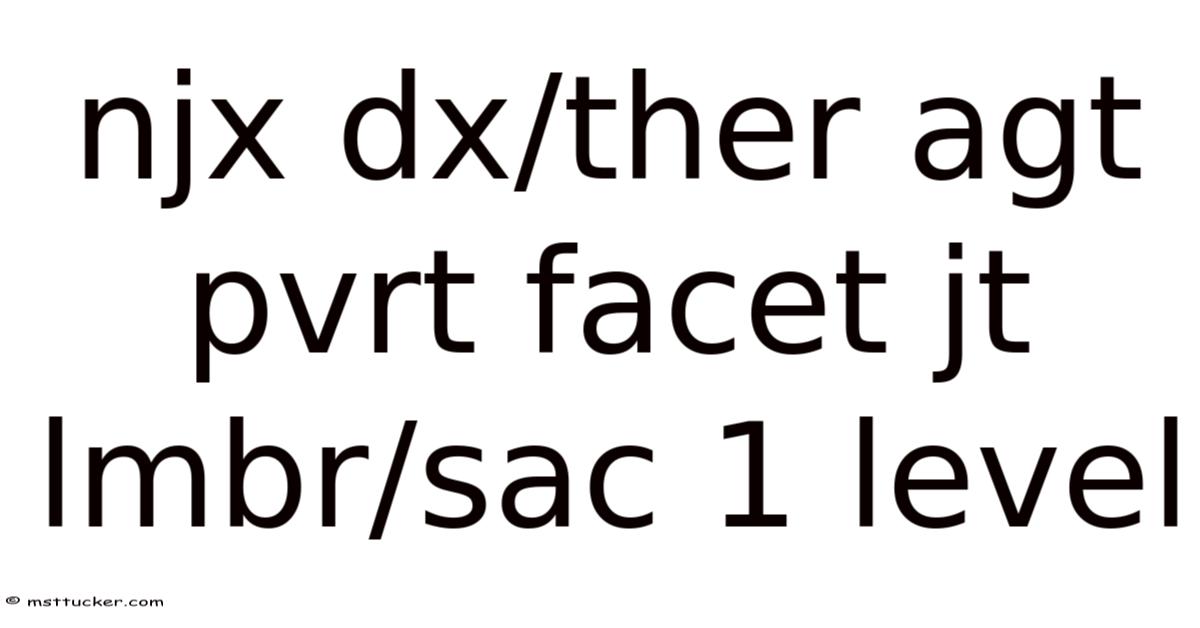
If you've been handed a cryptic MRI note that reads something like "njx dx/ther agt pvrt facet jt lmbr/sac 1 level," you're probably equal parts confused and worried. Here's the thing — the short version is: it's shorthand for a needle-based diagnostic or therapeutic attack on the facet joint at the lumbosacral junction — the L5-S1 spot where your lumbar spine meets your sacrum. And if you're dealing with that kind of pain, this stuff actually matters.
What Is Njx Dx/Ther Agt Pvrt Facet Jt Lmbr/Sac 1 Level
Look, that string of letters isn't some secret code from a sci-fi movie. It's the kind of abbreviated medical notation a radiologist or pain clinic might use. Let's break it down like a smart friend would.
"Njx" is needle injection. But "Facet jt" is the facet joint, those small stabilizing joints along the back of your spine. "Agt" is agent, like the medication or substance going in. In real terms, "Pvrt" stands for paravertebral, meaning near the vertebra. "Dx/ther" means diagnostic or therapeutic — so they're either trying to figure out if that joint is your pain source, or they're trying to calm it down. "Lmbr/sac 1 level" is the lumbosacral level — specifically L5-S1, the last lumbar vertebra meeting the sacrum.
The Facet Joint At L5-S1
Here's what most people miss: the facet joints aren't the squishy discs you hear about all the time. They're the hinges. Here's the thing — at L5-S1, that hinge takes a ridiculous amount of load every time you bend, twist, or just stand there. Because of that, when it gets irritated, it doesn't always hurt right where the joint is. It refers pain. Sometimes to the butt. Sometimes down the leg. Sounds like a disc, right? It isn't always Small thing, real impact..
Diagnostic Vs Therapeutic
Why the "dx/ther" split? In practice, a diagnostic injection uses a local anesthetic to see if numbing that specific joint kills the pain. So if it does, bingo — that's your culprit. Now, a therapeutic one adds steroid or another agent to reduce inflammation and give you relief that lasts longer than the numbing wears off. Same needle path, different goal.
Why It Matters / Why People Care
Turns out, a lot of lower back pain gets blamed on discs or muscles when the real troublemaker is the facet joint. And the L5-S1 facet is a frequent offender because it's a transition zone — built differently from the rest of your lumbar spine Practical, not theoretical..
What changes when you understand this? Now, for one, you stop chasing the wrong treatment. I know it sounds simple — but it's easy to miss. People get months of physical therapy for "disc pain" when their facet joint was screaming the whole time.
What goes wrong when people don't get it? In real terms, they get imaging that shows a "mild bulge" and assume that's the problem. Meanwhile the facet joint at lmbr/sac 1 level is inflamed and nobody's looking there. Real talk: MRI findings don't always match symptoms. A needle test clears that up fast Surprisingly effective..
And here's the thing — if you're considering surgery for unexplained L5-S1 pain, a facet injection can be the difference between an unnecessary operation and a 20-minute clinic visit that fixes it.
How It Works (or How to Do It)
This is the meaty middle. Let's walk through what actually happens with a njx dx/ther agt pvrt facet jt lmbr/sac 1 level procedure.
Before The Injection
You'll usually have a consult. The doctor reviews your history, your symptoms, maybe old imaging. They'll ask: does your pain worsen when you lean back or twist? Facet pain often does. Then they schedule the injection, often with fluoroscopy (live X-ray) or ultrasound guidance.
You're told not to eat a heavy meal beforehand if sedation's involved. And you'll need a ride home. Don't argue with that one.
The Procedure Itself
You lie face down on a table. The skin over the lower back gets cleaned and numbed with a tiny needle — that part stings, honestly, but it's quick. Then the real needle goes in, paravertebral, aimed at the facet joint capsule at L5-S1 Took long enough..
With fluoroscopy, they watch the tip land exactly where it needs to. The agent — local anesthetic, sometimes with steroid — gets injected. Whole thing can take 10 to 20 minutes. On top of that, you might feel pressure. You shouldn't feel terror, because you're awake but dulled.
Aftercare
You sit up. They watch you for a bit. Did the pain drop by 80% for two hours? Even so, if it was diagnostic, you'll be given a pain diary. The numbing might make your leg feel weird for an hour — that's normal. Then you go home. That's a positive. If therapeutic, you wait for the steroid to kick in over the next few days.
How Relief Happens
The local anesthetic confirms the source. The steroid, if used, calms the synovitis — that's the inflamed joint lining. For some people it's a few weeks of freedom. For others, it buys months. And sometimes, it's the gateway to a radiofrequency ablation that quiets the nerve for even longer Worth keeping that in mind..
Common Mistakes / What Most People Get Wrong
Honestly, this is the part most guides get wrong. They treat a facet injection like a magic bullet. It isn't.
One mistake: expecting permanent relief from a single therapeutic shot. The facet joint at lmbr/sac 1 level can flare again. That's anatomy, not failure And that's really what it comes down to..
Another: skipping the diagnostic logic. If they inject steroid without confirming the joint is the source, you might get partial relief and assume you're "fixed" while the real issue hides. A proper dx/therapeutic split answers the question instead of guessing Easy to understand, harder to ignore..
And here's a big one — people think "paravertebral" means "in the spine.Now, " It doesn't. The needle stays outside the spinal canal. That's why serious complications are rare. But clinics that rush without imaging guidance? That's where problems start.
Also, folks forget rehab. You got a pain-free window — use it. On top of that, strengthen the glutes, hips, and deep core so the L5-S1 facet isn't doing all the work. Needle helps. Muscles keep it helped Small thing, real impact..
Practical Tips / What Actually Works
Worth knowing: not every pain clinic does fluoroscopy for this. Now, ask. If they say "we just do it by feel," that's a red flag for a lumbosacral injection And that's really what it comes down to..
Track your response like a scientist. Write down pain scores at 1 hour, 4 hours, and next day after a diagnostic njx. Patterns beat memory It's one of those things that adds up..
If therapeutic helps but fades, ask about medial branch blocks and ablation. So those target the nerve feeding the facet, not the joint itself. Different tool, same goal.
And don't ignore sleep and walking. I've seen people get a great injection result then sit 10 hours a day and wonder why it returned. The L5-S1 joint loves movement. Short walks are free medicine That alone is useful..
One more: get a second opinion if someone jumps to fusion for L5-S1 pain without trying a facet injection first. That's not anti-surgery — it's pro-common-sense Surprisingly effective..
FAQ
How long does a diagnostic facet injection at L5-S1 last? The numbing lasts 1–4 hours. The information lasts forever — if your pain vanishes during that window, you've found the source.
Is the njx dx/ther agt pvrt facet jt lmbr/sac 1 level procedure painful? The skin pinch hurts for a second. The deep needle pressure is uncomfortable, not agonizing. Most say it's less bad than the toothache they came in with Turns out it matters..
Can I go back to work the same day? If it's diagnostic and no sedation, maybe. If you got sedation or therapeutic with steroid, take the day. Your leg might feel fuzzy No workaround needed..
Will insurance cover it? Usually yes, if conservative care (PT, meds) failed first
and the request is coded correctly with prior authorization. Denials often come from missing documentation that shows the stepwise approach — so keep your PT records and progress notes handy before the appointment Simple, but easy to overlook..
What if the injection doesn't help at all? That's still useful data. No response to a well-placed diagnostic block suggests the L5-S1 facet isn't your pain generator, and your provider should look at discs, sacroiliac joint, or referred sources. A negative result isn't a wasted procedure; it redirects the search.
How many times can you repeat a therapeutic injection? Most guidelines cap it at three per year per region. Beyond that, diminishing returns and steroid risks (bone density, glucose spikes) outweigh benefit. That's the point where medial branch ablation earns a serious conversation It's one of those things that adds up..
Bottom Line
A facet injection at the lumbosacral junction is a precise tool, not a cure and not a gamble. So used with imaging, clear diagnostic intent, and a rehab plan behind it, it can turn months of guessing into a named problem and a real window to fix the mechanics. Used carelessly — by feel, without follow-through, or as a substitute for movement — it's just a temporary quiet in a system still asking for help. In practice, the joint doesn't heal from the needle. It heals from what you do while the needle bought you the silence.
No fluff here — just what actually works.
