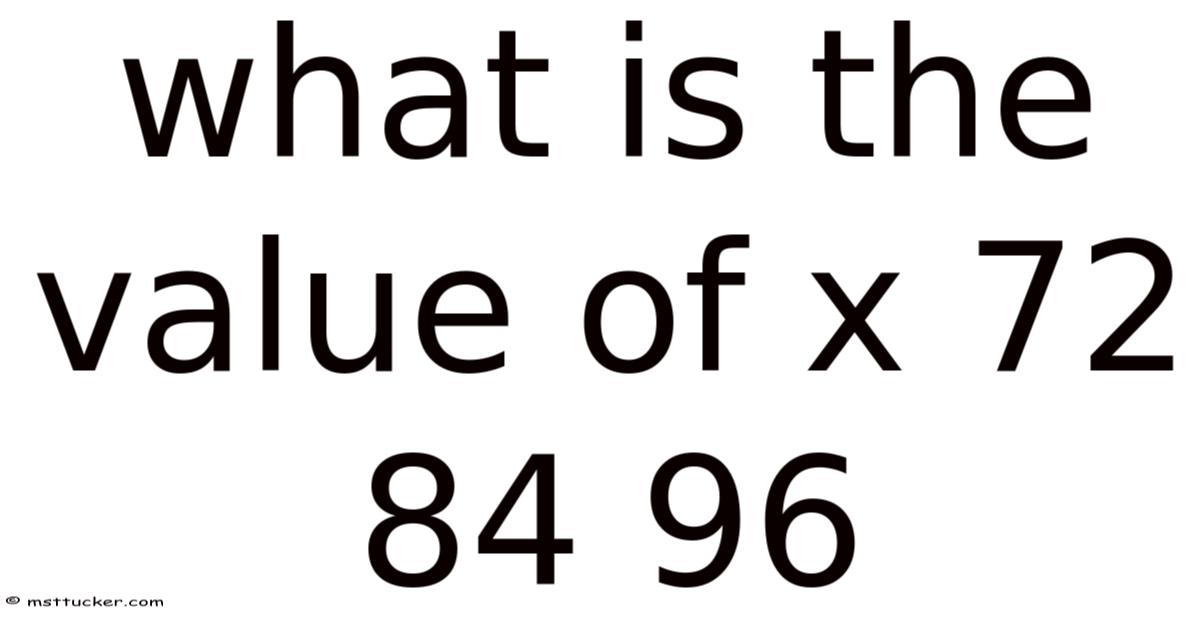
You're staring at a sequence: 72, 84, 96. Somewhere in there — or maybe before, maybe after — sits x. Find it.
Sounds like a puzzle. It is. But it's also a gateway into how patterns actually work, why your brain loves them, and where most people go wrong when the numbers stop being obvious.
What Is an Arithmetic Sequence
An arithmetic sequence is just a list of numbers where the gap between each pair stays the same. Add it again, you get the one after that. Add it once, you get the next term. That gap has a name: the common difference. Subtract it, you go backward Simple, but easy to overlook..
Simple? Sure. But simple things scale.
In the sequence 72, 84, 96, the common difference is 12.
84 − 72 = 12
96 − 84 = 12
That's it. That's the engine.
The General Formula
If the first term is a and the common difference is d, the nth term looks like this:
aₙ = a + (n − 1)d
No magic. Still, just bookkeeping. Plug in a = 72, d = 12, and you can generate any term in the sequence without writing them all out It's one of those things that adds up..
Want the 50th term?
72 + (50 − 1) × 12 = 72 + 588 = 660.
Done.
Why It Matters / Why People Care
You're not here because you need the 50th term of a random sequence. You're here because pattern recognition shows up everywhere — coding interviews, standardized tests, financial modeling, even music theory That's the whole idea..
Arithmetic sequences are the hello world of mathematical thinking. They teach you to:
- Spot structure in noise
- Generalize from three data points
- Predict forward and backward
- Check your work with a formula instead of hope
And honestly? Most people freeze at "find x." Not because the math is hard. Because they don't know where x lives.
Where Does x Go?
The prompt — "what is the value of x 72 84 96" — is ambiguous on purpose. Or at least, it feels that way. Three common setups:
- x, 72, 84, 96 — x is the first term
- 72, 84, 96, x — x is the next term
- 72, x, 84, 96 — x is missing in the middle
Each gives a different answer. And each tests a slightly different skill.
How It Works (or How to Solve It)
Let's walk through all three. Not because you'll see all three on a test — but because the thinking transfers Most people skip this — try not to..
Case 1: x, 72, 84, 96
Here, 72 is the second term. Because of that, the common difference is still 12 (84 − 72). So the first term is just 72 − 12 = 60 Less friction, more output..
Check: 60, 72, 84, 96. Differences all 12. Clean That's the part that actually makes a difference..
Case 2: 72, 84, 96, x
This is the most common interpretation. x is the 4th term.
96 + 12 = 108 Less friction, more output..
Check: 72, 84, 96, 108. Still arithmetic. Still 12.
Case 3: 72, x, 84, 96
Now x is the second term. Still, we know the 3rd term is 84 and the 4th is 96, so d = 12. Then x = 84 − 12 = 72 And that's really what it comes down to. Which is the point..
Wait. Worth adding: first difference: 0. That makes the sequence 72, 72, 84, 96.
Because of that, second: 12. Third: 12.
Not arithmetic. So this case is invalid unless the sequence isn't arithmetic — which changes everything Small thing, real impact..
But the prompt gave three terms that are perfectly arithmetic. So the only consistent placements for x are before 72 or after 96.
The Short Answer
If the sequence is arithmetic and the given terms are consecutive:
- x before 72 → 60
- x after 96 → 108
Most contexts assume x comes next. So 108 is the safe bet.
But the real answer is: it depends on position. And knowing that? That's the skill The details matter here..
Common Mistakes / What Most People Get Wrong
1. Assuming x Is Always the Next Term
People see "72 84 96 x" and autopilot to 108. Fine — until the question says "x 72 84 96" and they still answer 108. Position matters. Read the whole string.
2. Forcing Arithmetic When It's Not There
Sequences can be geometric (multiply by a constant), quadratic (differences change linearly), recursive (each term depends on previous two), or completely custom Simple, but easy to overlook..
Example: 2, 4, 8, 16...
Ratios: 2, 2, 2 — constant.
On the flip side, that's geometric. Differences: 2, 4, 8 — not constant.
x = 32 Less friction, more output..
If you force arithmetic on that, you get 14. Wrong.
3. Ignoring the "Given Terms Might Not Be Consecutive" Trap
Sometimes you get: 10, _, _, 22.
Still arithmetic.
Three jumps between term 1 and term 4.
Total gap: 22 − 10 = 12.
Two missing terms. So d = 12 ÷ 3 = 4.
Extending the Idea: More Missing Spots, More Possibilities
When you start looking beyond the simple “four consecutive terms” scenario, the same arithmetic mindset can be stretched in a few useful directions.
a) Multiple Gaps
Suppose the list reads 10, ____, ____, ____, 22 and you’re told the whole sequence is arithmetic.
There are now four intervals between the known endpoints, so the common difference is
[ d=\frac{22-10}{4}=3. ]
The full progression becomes 10, 13, 16, 19, 22.
The trick is always the same: total span ÷ number of steps gives the step size, then you walk forward or backward from any known term.
b) Non‑Consecutive Known Terms
Sometimes the given numbers aren’t spaced evenly. For example:
[ _,; 15,; _, ; 45,; _,; 75 ]
If the sequence is arithmetic, the common difference must be consistent across every adjacent pair.
Notice that the distance between 15 and 45 is two steps, and between 45 and 75 is also two steps.
Thus the overall span from 15 to 75 covers four steps, giving
[ d=\frac{75-15}{4}=15. ]
Working outward, the missing terms fall into place: 0, 15, 30, 45, 60, 75.
The key is to count how many intervals separate each pair of known numbers, not just the raw difference.
c) When Arithmetic Fails – Spotting Other Patterns
Arithmetic isn’t the only game in town. Recognizing when it doesn’t apply saves you from chasing a phantom pattern.
| Sequence | Differences | Ratio | What it suggests |
|---|---|---|---|
| 3, 6, 12, 24 | 3, 6, 12 (not constant) | 2, 2, 2 (constant) | Geometric – each term × 2 |
| 5, 9, 14, 20 | 4, 5, 6 (increasing by 1) | – | Quadratic – second‑order difference constant |
| 2, 5, 10, 17 | 3, 5, 7 (odd numbers) | – | Recursive – add successive odd numbers |
| 1, 1, 2, 3, 5 | 0, 1, 1, 2 | – | Fibonacci‑type – each term = sum of two before |
This is the bit that actually matters in practice But it adds up..
The moment you encounter a sequence where the first‑order differences aren’t steady, ask yourself:
- Are the second‑order differences constant? → quadratic behavior.
- Do ratios stay the same? → geometric behavior.
- Is there a recursive rule (e.g., “add the two previous terms”) that fits? → often a Fibonacci‑style pattern.
d) A Quick Decision‑Tree for Missing‑Term Problems
- Identify the position of the missing term (first, middle, last).
- Check whether the known terms are consecutive.
- If yes → compute the common difference directly.
- If no → count how many steps lie between each pair of known values.
- Test arithmetic first.
- Verify that every adjacent pair shares the same difference.
- If it holds, use (d) to fill the gap.
- If arithmetic fails, look for other patterns (geometric, quadratic, recursive).
- Validate your candidate answer by plugging it back into the full sequence and confirming consistency.
Conclusion
Missing‑term problems may look like simple “fill‑in‑the‑blank” exercises, but they are miniature investigations of pattern and structure. By:
- paying close attention to where the unknown sits,
- calculating the number of intervals between known values,
- confirming that a single common difference truly governs the whole list, and
- remaining open to alternative patterns when arithmetic collapses,
you turn each puzzle into a clear, logical solution rather than a guessing game Simple as that..
The next time you see a string of numbers with a blank, remember: the answer isn’t hidden in the numbers themselves—it’s hidden in the relationship they share. Spot that relationship, and the missing term will reveal itself Not complicated — just consistent..
